
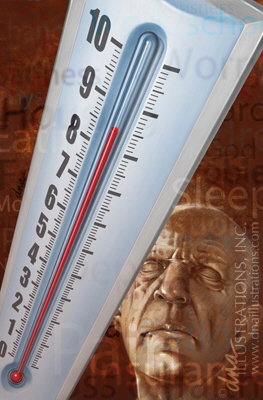
Illustration that literally portrays a "distress" thermometer with a cancer patient in the background, surrounded by words indicating different factors that concern patients with cancer. Illustration is based on an initial screening tool used to survey patients psychosocial distress levels from 0 (no distress) to 10 (extreme distress). This rating scale identifies distress from any source, even unrelated to cancer. The distress thermometer is accompanied by a problem list. The 35-item problem list prompts patients to identify their problems in five different categories: practical, family, emotional, spiritual/religious, and physical. Scores of 4 or higher suggest a level of distress that has clinical significance.
Illustration copyright at @DNA Illustrations, Inc.
