


The main challenge was to assemble the hardware of a Virtual Reality Cave, and then develop an immersive terrain exploration technique, that would help users navigate through a 3D virtual environment.

Four main stages were identified to ultimately build up to the final result.

The outer framework of the cave was initially assembled before snap-fitting each screen onto its corresponding frame. The cave was made up of three screens in total - a front facing screen, a left screen, and a right screen.

A Toshiba digital multimedia projector was positioned behind each screen, and the projected images were adjusted so as to take up all available surface area on the screens.
The projectors were then connected to a central computer through a multi-display adapter known as the "Matrox Triple Head2Go" adapter. This adapter helped to split the output display from the computer into three separate output channels that were then fed into each projector.
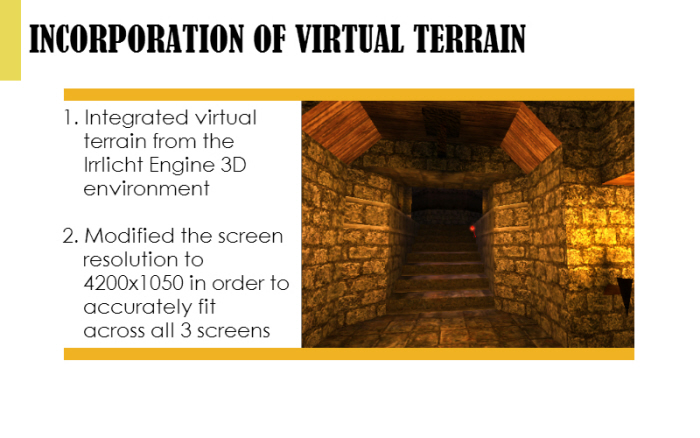
The 3D virtual terrain that was used, was adapted from a tutorial series based on a 3D engine known as the "Irrlicht Engine".
The scene that was adapted for use in this project can be found on:
http://irrlicht.sourceforge.net/docu/example007.html

A Wiimote was chosen to navigate through the virtual environment because of it's ease of use, versatility, and also because of the fact that it is a very economical input device.
The Wiimote was first paired to the central computer through Bluetooth connectivity, and was then programmed to act as an input emulator to the computer. The software that was used to program the Wiimote was an input emulator known as GlovePIE.
gLike
Terrain Exploration using a Virtual Reality Cave
This project was a class assignment for a course entitled "Virtual Reality Apps", at the University at Buffalo, in the Spring of 2013.
The project involved developing an immersive method to explore a 3D environment, by building a Virtual Reality Cave. Other members of my team who aided in developing the project were fellow students - Azhar Vellore, and Dana Kerker.
